
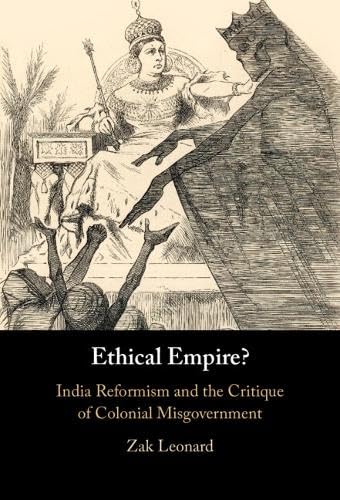
Ethical empire? : India reformism and the critique of colonial misgovernment
Material type: TextLanguage: English Publication details: New Delhi : Cambridge University Press, 2024.Description: ix, 292pISBN:
 - 9781009321068
- V2'N R4
 Textual
| Item type | Current library | Home library | Call number | Status | Barcode | |
|---|---|---|---|---|---|---|
|
Textual
|
South Campus Library | South Campus Library | V2'N R4 (Browse shelf(Opens below)) | Available | SC1690737 |
Browsing South Campus Library shelves Close shelf browser (Hides shelf browser)


This study centers upon the abolitionists, Quakers, free-traders, disenchanted colonial agents, and Parsi intellectuals who participated in the British India Society, India Reform Society, and East India Association. Beginning in the 1830s, these agitators increasingly recognized that British dominion in India was exploitative and destabilizing; moreover, it had given rise to a series of prejudicial anomalies. Reformers therefore denounced the 'virtual' enslavement, infrastructural decay, violations of the law of nations, and economic impoverishment that had occurred under colonial rule, as well as the metropole's inattention to Indian affairs. By reconstructing the transregional networks that extended from Boston to Bengal and sustained these organizations, Zak Leonard analyzes India reformism from ideological and structural perspectives. In so doing, he historicizes the practice of anti-colonial critique and offers new insight into the frustrated development of a British imperial public consciousness.
There are no comments on this title.