
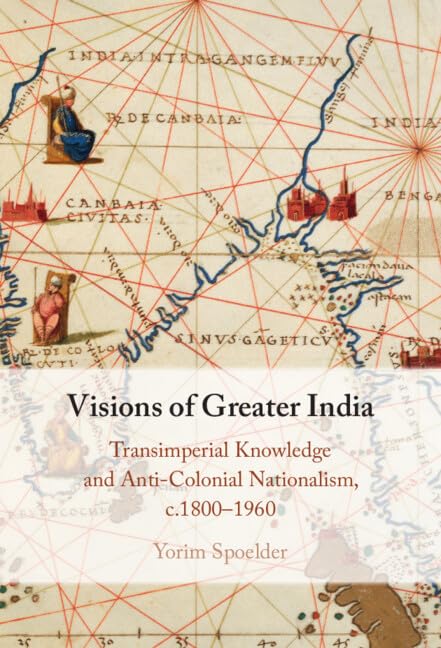
Visions of greater India : Transimperial knowledge and anti-colonial nationalism, c.1800-1960
Material type: TextLanguage: English Publication details: New Delhi : Cambridge University Press, 2024.Description: xiii, 331pISBN:
 - 9781009403160
- V2'N R4
 Textual
| Item type | Current library | Home library | Call number | Status | Barcode | |
|---|---|---|---|---|---|---|
|
Textual
|
South Campus Library | South Campus Library | V2'N R4 (Browse shelf(Opens below)) | Available | SC1690744 |
'Greater India' was a transimperial, Indocentric research paradigm that informed the colonial recovery of the ancient past in Central and Southeast Asia. Ancient India was postulated as the fount of an expansive classicism - an actor in world history on a par with ancient Greece and Rome. Under the Greater India movement, the scholarly quest for 'India in Asia' became tied to anti-colonial, pedagogical, nationalist and Asianist agendas. Yet although it provided a potent anti-colonial imaginary, the movement also bolstered visions of Indian exceptionalism and energized Hindu nationalist ideas of India as a civilizing, colonizing power. Speaking directly to debates that define and divide India today, this is essential reading for those interested in the legacies of Orientalist scholarship and interwar visions of Indian internationalism. This title is part of the Flip it Open Programme and may also be available Open Access. Check our website Cambridge Core for details.
There are no comments on this title.