
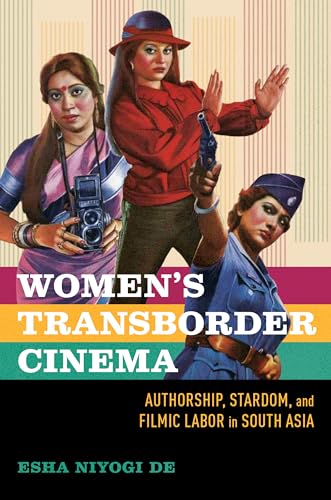
Women's transborder cinema: Authorship, stardom, and filmic labor in South Asia
Material type: TextLanguage: English Series: Women's media history now!Publication details: Chicago, USA: University of Illinois Press, 2024.Description: xii, 285p. cmContent type:
 - text
- unmediated
- volume
- 9780252046209
- 9780252088285
- NW49G R4
 Textbook
| Item type | Current library | Home library | Call number | Status | Barcode | |
|---|---|---|---|---|---|---|
|
Textbook
|
Central Library | Central Library | NW49G R4 (Browse shelf(Opens below)) | Available | CL1923656 |
Browsing Central Library shelves Close shelf browser (Hides shelf browser)

|

|

|

|

|

|
No cover image available | ||
| NW44wN24 152Q0 राजकपूर: सृजन प्रक्रिया | NW44:(Y592) R6 Routledge companion to caste and cinema in India | NW45 164P7 Pasukh bah Tareekh | NW49G R4 Women's transborder cinema: Authorship, stardom, and filmic labor in South Asia | NW5,P 152Q2;Q8 पश्चिम और सिनेमा | NW6:g R3 African film studies: an introduction | O152,6N58x Q1 वहॉं मलय सागर तक |
Includes bibliographical references and index.
Decoupled maternities : female stars in production modes, Kolkata -- Public maternities : women's companies and a sororal production mode, Dhaka -- Performing bodies : entertainer authors and small-scale Urdu cinema in Lahore studios -- Timing bodies : Hindi cinema and a female brand author at Bollywood scale -- Families out of bounds : the pirate mode and women's coproductions across Pakistan and Bangladesh -- Families torn and found : feminist modes and transnational Bangla media.
"Can we write women's authorial roles into the history of industrial cinema in South Asia? How can we understand women's creative authority and access to the film business infrastructure in this postcolonial region? Esha Niyogi De draws on rare archival and oral sources to explore these questions from a uniquely comparative perspective, delving into examples of women holding influential positions as stars, directors, and producers across the film industries in India, Pakistan, and Bangladesh. De uses film tropes to examine the ways women directors and film entrepreneurs claim creative control within the contexts of anti-colonial nationalism and global capitalism. The region's fictional cinemas have become staging grounds for postcolonialism, with colonial and local hierarchies merged into new imperial formations. De's analysis shows how the gendered intersections of inequity and opportunity shape women's fiction filmmaking while illuminating the impact of state and market formations on the process. Innovative and essential, Women's Transborder Cinema examines the works of South Asia's women filmmakers from a regional perspective"-- Provided by publisher.
There are no comments on this title.