
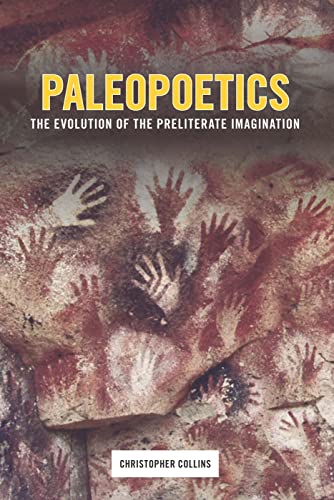
Paleopoetics : the Evolution of the Preliterate Imagination
Material type: TextLanguage: English Publication details: New York: Columbia University, 2013.Description: xiv, 251p. : illISBN:
 - 9780231160926
- Y72:(O111,1), Q3
 Textual
| Item type | Current library | Home library | Call number | Status | Barcode | |
|---|---|---|---|---|---|---|
|
Textual
|
Central Science Library | Central Science Library | Y72:(O111,1) Q3 (Browse shelf(Opens below)) | Available | SL1598395 |
Bibliography 227-246p.; Index 247-251p.
Christopher Collins introduces an exciting new field of research traversing evolutionary biology, anthropology, archaeology, cognitive psychology, linguistics, neuroscience, and literary study. Paleopoetics maps the selective processes that originally shaped the human genus millions of years ago and prepared the human brain to play, imagine, empathize, and engage in fictive thought as mediated by language. A manifestation of the "cognitive turn" in the humanities, Paleopoetics calls for a broader, more integrated interpretation of the reading experience, one that restores our connection to the ancient methods of thought production still resonating within us. Speaking with authority on the scientific aspects of cognitive poetics, Collins proposes reading literature using cognitive skills that predate language and writing.
There are no comments on this title.